


The distance between women of different generations rarely appears in grand arguments. It surfaces instead in habitual phrases: “That kind of thing always happened,” “It wasn’t really that serious,” “People are too sensitive now.” These remarks do not necessarily come from contempt, but from a different memory of how the world once worked.
For many women who grew up in an earlier era, harassment was not something to be named, let alone reported. It was a condition to be managed. Comments, unwanted advances, casual intrusions into one’s body or space were woven into daily life and absorbed in silence. Society offered few forms of protection and many reasons for blame. When something happened, responsibility seemed to fall, almost automatically, on the woman herself.
Younger women today move through a changed landscape. Not a just one, perhaps, but a more articulate one. There is now language to describe what once remained blurred or normalized, and a greater legitimacy in setting boundaries when those boundaries are crossed. Accusation is no longer solely a private act; it has, at least in part, a public vocabulary and an audience.
It is precisely this shift that sometimes produces friction. Some women from older generations respond to younger women’s accounts by diminishing what happened—not outright denying it, but rendering it smaller, more manageable, less urgent. Social psychology offers a useful lens here: cognitive dissonance. To fully accept another woman’s experience would require reexamining one’s own, acknowledging that what was once endured was neither inevitable nor benign.
Revisiting the past carries discomfort. To avoid it, the mind seeks coherence. Minimizing another’s pain becomes a way of preserving one’s internal narrative. And so a distance emerges—not between those who suffered more or less, but between those who can name what happened and those who learned to survive without naming it at all.
Perhaps bridging this distance does not require choosing sides, but recognizing that listening to younger women today may also be a way of acknowledging what went unacknowledged in oneself for far too long.
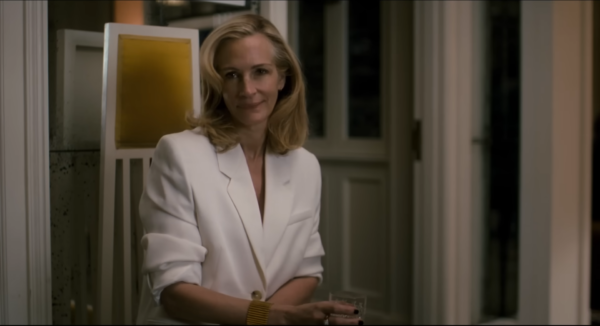
(Cover photo: scene taken from the trailer of the film After the Hunt – Dopo la caccia, directed by Luca Guadagnino)
❤️ Support Florence Daily News
If you liked this article, please consider supporting Florence Daily News.
We are an independent news site, free from paywalls and intrusive ads, committed to providing clear and reliable reporting on Florence and Tuscany for everyone.
Your support — whether a one-time gift or a regular contribution — helps us stay independent and keep telling the stories that matter.
Donate securely via Stripe below.
Make a one-time donation
Make a monthly donation
Make a yearly donation
Choose an amount
Or enter a custom amount
Your contribution is appreciated.
Your contribution is appreciated.
Your contribution is appreciated.
DonateDonate monthlyDonate yearly

Eirini Lavrentiadou is an actress and singer, born in Thessaloniki in 1992. She lives in Florence, where she trained at the city’s Theatre Academy and the Fiesole School of Music. She has performed in classical Greek and European plays, worked with international directors and companies, and appeared in concerts ranging from opera to jazz. She contributes to Florence Daily News as a writer.