


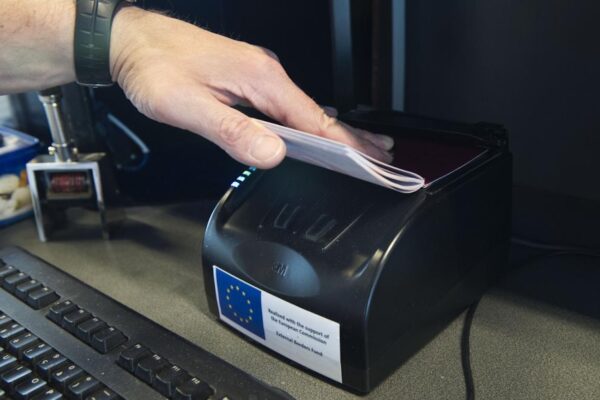
Travelers arriving in Italy from outside the European Union could face longer waits at airports and border checkpoints from Sunday, September 6, as temporary flexibility measures linked to Europe’s new biometric Entry/Exit System come to an end.
The change could be particularly relevant for Tuscany as the region moves through the final stretch of its busy international tourism season, with Florence and Pisa serving as major gateways for visitors from the United Kingdom, the United States and other non-EU countries.
The European Entry/Exit System, known as EES, electronically records the entry and exit of non-EU travelers crossing the external borders of participating European countries. The system uses biometric information, including fingerprints and facial images, replacing much of the traditional passport-stamping process.
After a gradual rollout beginning in October 2025, the system became fully operational at participating European border crossings on April 10, 2026.
During the summer, however, European countries were allowed greater flexibility in exceptional circumstances. Border authorities could temporarily suspend some biometric data collection at individual crossing points when passenger volumes threatened to produce excessive waiting times.
That temporary flexibility is due to end on September 6, 2026.
Why It Matters for Travelers to Italy
The end of the summer measures does not mean that travelers need a new document to enter Italy on September 6. Rather, it means border authorities will have less room to temporarily ease biometric procedures simply because passport-control areas are congested.
For passengers, the most visible consequence could therefore be longer queues, particularly during peak arrival periods.
The European Commission said this week that the EES had generally performed well over the summer and stressed the benefits of the new system. At the same time, European officials acknowledged that adjustments are still required at some border crossing points.
The airline industry has been more cautious.
The International Air Transport Association (IATA) has warned that passport processing that previously took roughly 20 to 25 seconds can take around 90 seconds under the EES. The organization has called for the temporary flexibility provisions to remain available beyond September, at least through the winter season.
Travel industry representatives have also advised passengers not to rely on tight connections when their journeys involve European border controls.
Florence and Pisa: What Tuscany Travelers Should Know
For Tuscany, the issue is especially significant because international tourism remains a central part of the regional economy.
Florence Airport and Pisa International Airport handle large numbers of international passengers, while many visitors to Tuscany also enter the Schengen area through major European hubs before continuing to the region.
This distinction is important.
A traveler flying from London directly to Tuscany, for example, may encounter EES procedures on arrival in Italy. A passenger traveling from New York to Florence via Paris, Frankfurt or Amsterdam would normally cross the Schengen external border at the first European point of entry rather than in Florence.
As a result, delays elsewhere in Europe can also affect travelers heading to Tuscany, particularly those with short connecting times.
Visitors arriving through airports outside Tuscany — including Rome or Milan — before continuing to Florence by train, car or domestic flight could likewise encounter additional processing at their first Schengen border checkpoint.
A Sensitive Moment for Tuscany’s Tourism Season
September remains an important month for tourism in Florence and across Tuscany.
While the peak August holiday period is over, Florence, Siena, Lucca, Pisa and Tuscany’s wine regions continue to attract large numbers of international visitors during the early autumn. September is also a popular period for weddings, cultural travel, food and wine tourism and organized tours.
Even relatively modest delays at European border controls can therefore ripple through a visitor’s itinerary, particularly when travelers have booked connecting flights, airport transfers, trains or scheduled tours shortly after arrival.
Travelers from the United Kingdom may want to pay particular attention. Since Brexit, British citizens are treated as third-country nationals for the purposes of the EU’s external border system and are therefore among the travelers affected by EES procedures.
The same applies to many visitors from the United States, Canada, Australia and other non-EU countries traveling to Italy for short stays.
EU citizens are not processed through the EES in the same way.
EES Is Not ETIAS
Travelers should also avoid confusing the Entry/Exit System with ETIAS, the European Travel Information and Authorisation System.
The two systems serve different purposes.
EES is a border-management system that records when eligible non-EU travelers enter and leave participating European countries and collects biometric information as part of that process.
ETIAS, by contrast, is a separate pre-travel authorization for visa-exempt travelers. Its introduction follows a different timetable.
For tourists planning a trip to Florence or elsewhere in Italy, the immediate issue from September 6 is therefore the operation of EES at the border — not a sudden new September 6 application requirement.
Allow More Time
Travel industry specialists are advising passengers to build additional time into journeys involving European border controls, particularly when making connections.
Arriving at an airport earlier can help before departure, but it cannot eliminate delays encountered at passport control after landing. Travelers connecting through another European airport should therefore be cautious about booking itineraries with very short transfer windows.
For visitors heading to Florence and Tuscany in the coming weeks, the practical message is straightforward: check where you will first enter the Schengen area, allow more time for border formalities and avoid scheduling critical onward connections too tightly.
The new biometric system is intended in the long term to make Europe’s external borders more secure and efficient. But as the summer flexibility period ends, September will provide an important test of how well the system handles international passenger traffic without the temporary safety valve available during its first full summer.
For Tuscany — where international visitors remain an essential part of the tourism economy — the performance of Europe’s borders hundreds of kilometers away can ultimately determine how smoothly a holiday in Florence begins.
(Cover photo via European Commission website)
❤️ Support Florence Daily News
If you liked this article, please consider supporting Florence Daily News.
We are an independent news site, free from paywalls and intrusive ads, committed to providing clear and reliable reporting on Florence and Tuscany for everyone.
Your support — whether a one-time gift or a regular contribution — helps us stay independent and keep telling the stories that matter.
Donate securely via Stripe below.
Make a one-time donation
Make a monthly donation
Make a yearly donation
Choose an amount
Or enter a custom amount
Your contribution is appreciated.
Your contribution is appreciated.
Your contribution is appreciated.