


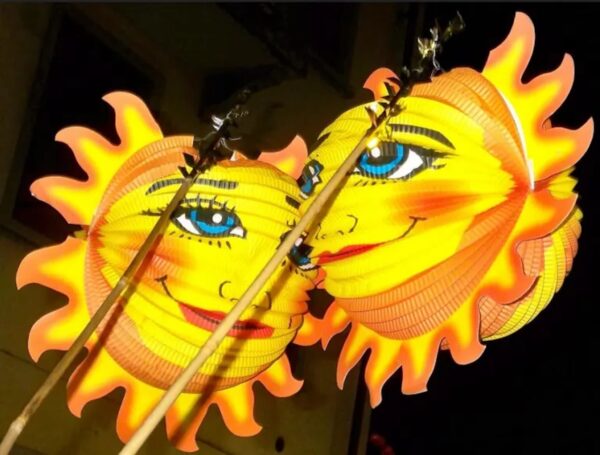
Florence will celebrate one of its oldest popular traditions on Monday, September 7, 2026, when children and families take to the streets carrying the colourful paper lanterns known as rificolone.
The main gathering will take place in Piazza Santissima Annunziata at 9 p.m., continuing a tradition closely connected with the square and its basilica. Events are also being organised in neighbourhoods across Florence, with lantern-making workshops, processions and activities for children.
For visitors, the evening may look like a simple children’s lantern festival. Its origins, however, can be traced back more than three centuries to the religious and commercial life of Florence.
From country pilgrims to paper lanterns
The Rificolona is traditionally celebrated on September 7, the eve of the Catholic feast of the Nativity of the Virgin Mary.
The Basilica of Santissima Annunziata, on the northern edge of Florence’s historic centre, has for centuries been an important place of Marian devotion. From around the 17th century, farmers, merchants and pilgrims travelled to Florence from the surrounding countryside for the religious celebrations and a market held around the basilica.
Many set out before dawn or travelled through the night so they could reach the city in time and find a good place to sell their goods. They carried lanterns made from paper or cloth, attached to poles, to illuminate the roads into Florence.
Those lights gradually became associated with the September celebrations and provided the model for the lanterns carried through Florence today.
The connection with the old market has not disappeared entirely. Florence’s regulations still provide for a Rificolona fair in Piazza Santissima Annunziata on September 7 and 8, with stalls and activities linked to the traditional celebration.
Where does the name Rificolona come from?
The origin of the word itself is less certain.
One commonly cited explanation connects rificolona with fierucolona or similar terms once used by Florentines to mock women from the countryside who came into the city for the fair.
Their rural clothing and the large baskets of produce they carried made them targets for the irreverent humour of city residents. Over time, according to this interpretation, the nickname was transferred to the lanterns and eventually to the celebration itself.
There is no definitive explanation of the word’s etymology, however, and accounts of its origins vary.
How the Rificolona became a children’s festival
Over the centuries, the Rificolona gradually developed beyond its religious origins and became a popular neighbourhood celebration, particularly for children.
The traditional lantern is made from coloured or translucent paper stretched over a light frame and attached to a stick. Older versions contained a candle, while modern lanterns may use safer electric lights.
Their shapes have also changed considerably. Alongside traditional handmade lanterns, children now carry rificolone depicting animals, objects and cartoon characters.
The celebration has retained its playful side. Generations of Florentine children have walked through the streets with their lanterns while singing the traditional Rificolona rhyme, and historically some participants tried to puncture or set fire to other children’s paper lanterns using blowpipes — a custom that helps explain why modern versions increasingly use electric lights.
Rificolona 2026 in Florence
Piazza Santissima Annunziata remains the symbolic centre of the celebration, with the main gathering scheduled for 9 p.m. on Monday, September 7.
But the Rificolona is not confined to the city centre. Florence’s municipal districts are organising their own events for families. In Quartiere 4, for example, the programme includes workshops, entertainment, games, music and a lantern procession, while Quartiere 5 has announced several activities for children and families.
The National Archaeological Museum of Florence, located directly on Piazza Santissima Annunziata, will also take part in the evening. It is scheduled to remain open from 6 p.m. to 10 p.m. on September 7, with activities including a visit connected with ancient Egyptian traditions involving lamps and a workshop for children aged six to 11.
More than three centuries after country travellers used lanterns to find their way into Florence at night, the small paper lights remain the most recognisable symbol of the September festival.
❤️ Support Florence Daily News
If you liked this article, please consider supporting Florence Daily News.
We are an independent news site, free from paywalls and intrusive ads, committed to providing clear and reliable reporting on Florence and Tuscany for everyone.
Your support — whether a one-time gift or a regular contribution — helps us stay independent and keep telling the stories that matter.
Donate securely via Stripe below.
Make a one-time donation
Make a monthly donation
Make a yearly donation
Choose an amount
Or enter a custom amount
Your contribution is appreciated.
Your contribution is appreciated.
Your contribution is appreciated.