


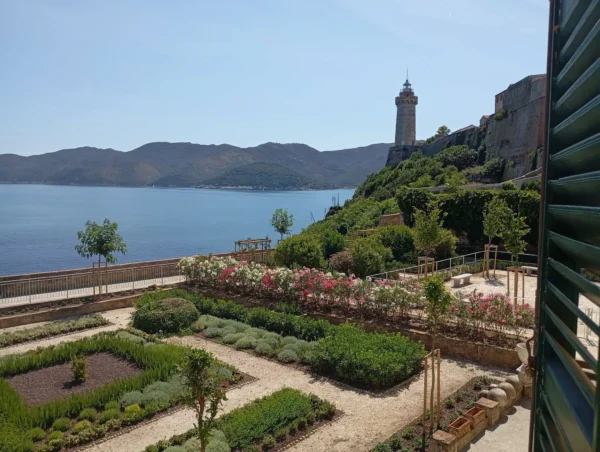
Visitors to Elba can once again explore the island’s two historic Napoleonic residences following a major restoration project funded through Italy’s National Recovery and Resilience Plan (PNRR). The reopening of the Palazzina dei Mulini and Villa San Martino adds a new cultural attraction to one of Tuscany’s most popular seaside destinations.
The project, backed by a €2 million investment, has restored historic gardens, pathways, terraces and green spaces that had long been inaccessible or in need of conservation work. It offers travellers the opportunity to combine beach holidays with a journey through one of the most remarkable chapters of European history.
The reopening also coincides with the exhibition 50 Years of Creation by Tuscan sculptor Andrea Roggi, displayed across the Palazzina dei Mulini, Villa San Martino and Portoferraio’s waterfront.
Restored gardens overlooking the sea
At the Palazzina dei Mulini, located within Portoferraio’s historic Medici fortifications, restoration work focused on the reconstruction of the original Italian-style garden, historic pathways, terraces and panoramic viewpoints overlooking the harbour.
More than 5,000 square metres of gardens have been returned to public use, with historical plant varieties reintroduced according to archival sources.
At Villa San Martino, Napoleon’s country residence a few kilometres outside Portoferraio, the project restored historic walkways, ornamental fountains, water basins and landscaped green areas, reopening around 35,000 square metres of historic parkland.
Napoleon’s brief but lasting legacy on Elba
Napoleon Bonaparte arrived on Elba in May 1814 after his abdication following the Treaty of Fontainebleau. Granted sovereignty over the island, he established a small court and administration while Europe believed his political career had come to an end.
His exile lasted less than ten months. During that time he reorganised local administration, promoted improvements to roads and transport, encouraged agriculture, fishing and trade, and sought to modernise the island’s economy. Several ambitious projects remained unfinished when he departed in February 1815 and returned to France for the campaign known as the Hundred Days.
Despite the short duration of his stay, Napoleon’s presence remains one of the defining elements of Elba’s identity and continues to attract visitors from around the world.

The Palazzina dei Mulini: Napoleon’s official residence
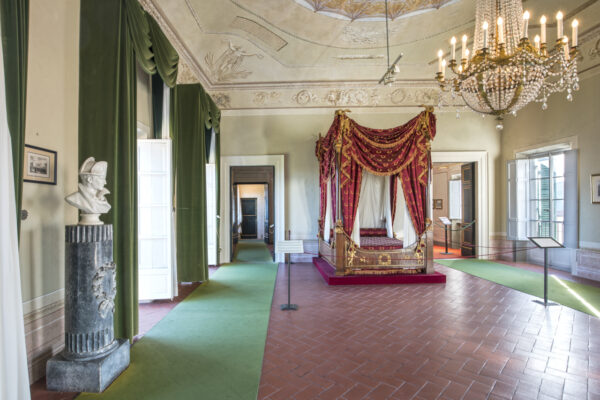
The Palazzina dei Mulini served as Napoleon’s principal residence and the centre of political and social life during his exile. Built on a strategic position overlooking Portoferraio’s harbour, it was created by converting existing military buildings and reshaping the surrounding area.
Napoleon personally supervised many aspects of the project, from architectural modifications to the choice of furnishings and decorations. The residence hosted members of his family, including his mother Letizia Bonaparte and his sister Pauline, helping recreate a reduced version of the imperial court.
Today the museum preserves period furniture, personal memorabilia and part of the library assembled by Napoleon during his stay on the island.
A remarkable library of more than 2,300 books
Even during exile, Napoleon maintained his passion for books. Within a few months he gathered a collection of 2,378 volumes, ranging from classical history and literature to military, political and scientific works.
The first group of books came directly from the libraries of Fontainebleau, selected by Napoleon shortly before leaving France. Additional volumes were sent by his uncle Cardinal Joseph Fesch, purchased in Italian cities including Livorno, or inherited from military institutions already present on the island.
History was the dominant subject, reflecting Napoleon’s lifelong interest in political and military affairs. The collection also included works by Homer, Virgil, Ovid, Voltaire, Molière and Racine. Before leaving Elba, Napoleon donated the library to the community of Portoferraio, creating one of the island’s most significant cultural legacies.
Villa San Martino and Napoleon’s private life
While the Palazzina dei Mulini represented Napoleon’s public life, Villa San Martino was intended as a more private retreat in the countryside.
Purchased in June 1814 as a summer residence, the villa remained largely unused because of Napoleon’s sudden departure from Elba. In later decades it was acquired by Prince Anatole Demidoff, who married into the Bonaparte family and commissioned the imposing neoclassical gallery that still bears his name.
Visitors can admire period furnishings, historic decorations and the villa’s celebrated Egyptian Room, one of the most distinctive interiors associated with Napoleon’s stay on the island.
More than a beach destination
For many visitors, Elba is synonymous with crystal-clear waters, sandy beaches and Mediterranean landscapes. Yet the island also offers one of the most significant Napoleonic heritage sites in Europe.
The restoration of the two residences strengthens Elba’s appeal as a destination where nature, history and culture meet. Travellers can spend the morning on the beach and the afternoon exploring the places where Napoleon planned the next chapter of his extraordinary career before returning to France in 1815.
Practical information
The Palazzina dei Mulini and Villa San Martino are open to visitors as part of the Napoleonic Residences museum network. Both sites are located near Portoferraio, the island’s main town and port, which is connected year-round by ferry services from the Tuscan mainland.
❤️ Support Florence Daily News
If you liked this article, please consider supporting Florence Daily News.
We are an independent news site, free from paywalls and intrusive ads, committed to providing clear and reliable reporting on Florence and Tuscany for everyone.
Your support — whether a one-time gift or a regular contribution — helps us stay independent and keep telling the stories that matter.
Donate securely via Stripe below.
Make a one-time donation
Make a monthly donation
Make a yearly donation
Choose an amount
Or enter a custom amount
Your contribution is appreciated.
Your contribution is appreciated.
Your contribution is appreciated.