


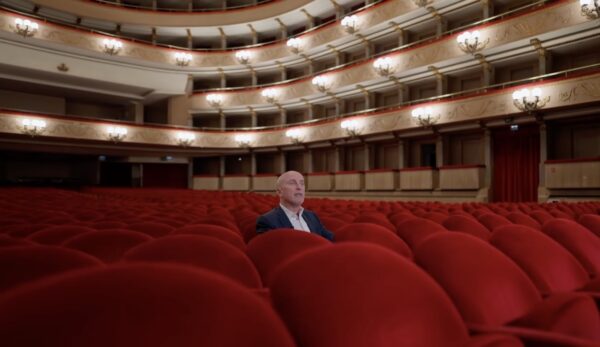
What links a medieval castle, a city prison, a laxative syrup and a theatre?”. This is the question that guides the story told by Fulvio Palmieri, long-time front-of-house manager of Florence’s Teatro Verdi, who has spent nearly 35 years working inside the venue and studying its past.
In the episode of Passeggiate nella storia embedded below, Palmieri retraces more than 700 years of history of the building that today hosts the theatre, but which for over five centuries served as Florence’s main prison. Through anecdotes and lesser-known episodes, his account connects daily life, entrepreneurship and entertainment, offering a glimpse into how the city evolved over time.
He also reflects on the theatre’s more than 170 years of activity, describing it as a space that has always maintained a strong connection with the public, in line with the vision of its founder Girolamo Pagliano, and highlighting its defining feature: versatility.
From prison to theatre
The Teatro Verdi stands on the site of the former Stinche prison, once the main detention facility in Florence. The prison remained in use for around 500 years before being dismantled in the 19th century.
The area was then redeveloped into a large residential complex, within which a theatre space was created in the early 1850s. Originally named Teatro Pagliano, it was one of the largest theatres in Italy at the time, with a capacity of about 4,000 spectators.
The theatre officially opened in 1854 with Verdi’s Rigoletto and quickly became a central venue for opera, drama and civic events during a crucial period in Italy’s history.
A theatre that adapted over time
After financial difficulties and a fire in the 1860s, the venue changed ownership and was eventually renamed Teatro Verdi in 1901.
Throughout the 20th century, it adapted to changing cultural trends, hosting operettas, variety shows, cinema screenings and concerts. Major renovations after the Second World War reshaped the interior while preserving its historic character.
Today, with around 1,500 seats, the theatre is managed by the Fondazione Orchestra Regionale Toscana and continues to play an active role in Florence’s cultural life.
Watch the story
The full story is told in the video below, part of the Passeggiate nella storia series.
The video is embedded from YouTube and can be followed using automatically generated subtitles, which can be activated directly on the platform.

Why it matters
The Teatro Verdi is not only a performance venue but also a layered historical site that reflects the transformation of Florence across centuries.
From prison to theatre, its evolution mirrors broader changes in the city, making it a place where architecture, memory and cultural life intersect.
❤️ Support Florence Daily News
If you liked this article, please consider supporting Florence Daily News.
We are an independent news site, free from paywalls and intrusive ads, committed to providing clear and reliable reporting on Florence and Tuscany for everyone.
Your support — whether a one-time gift or a regular contribution — helps us stay independent and keep telling the stories that matter.
Donate securely via Stripe below.
Make a one-time donation
Make a monthly donation
Make a yearly donation
Choose an amount
Or enter a custom amount
Your contribution is appreciated.
Your contribution is appreciated.
Your contribution is appreciated.
DonateDonate monthlyDonate yearly