


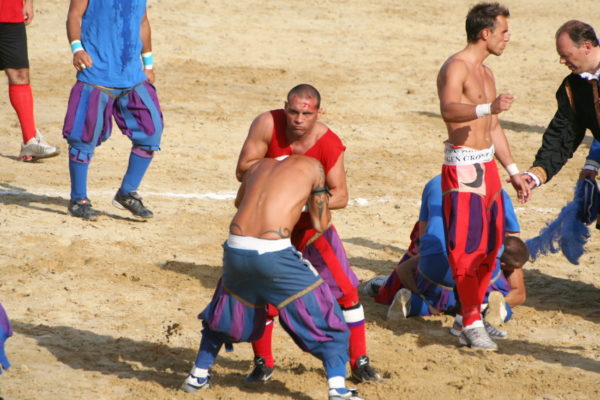
On 17 February 1530, while imperial troops surrounded Florence, 54 young nobles played a game of football in Piazza Santa Croce. The match, held in open defiance of the besieging army, has become one of the most symbolic episodes of the city’s last stand as a republic — a stand in which Michelangelo also played an unexpected role.
At the time, Florence was under siege by the forces of Emperor Charles V, who sought to restore the Medici family to power after the city had expelled them and re-established a republic in 1527.
The siege had begun on 14 October 1529. Imperial troops, led by Philibert of Chalon and Pier Maria III de’ Rossi, encircled the city. Florence resisted despite dwindling supplies and mounting pressure.
In that context, the football match in Piazza Santa Croce was more than a game. It was a deliberate act of defiance. According to contemporary accounts, music was played loudly to drown out the sound of enemy cannon fire. The teams represented two of the city’s historic quarters: the Bianchi of Santo Spirito and the Verdi of San Giovanni. The final score was never recorded.
Michelangelo and the Defence of the Republic
While young nobles were staging symbolic resistance in the square, Florence was fighting a real military battle along its walls.
Among those entrusted with the city’s defence was Michelangelo Buonarroti. In 1529, the republican government appointed him governor and procurator general of fortifications. Known above all as a sculptor and painter, Michelangelo was also trained in architecture and engineering.
His task was to adapt Florence’s medieval walls to the realities of modern artillery. Cannon fire had made vertical stone walls vulnerable, and Michelangelo studied new defensive systems based on angled bastions and reinforced earthworks designed to absorb impact.
He produced detailed drawings for strengthening key sectors of the perimeter, particularly on the southern side of the city. Several of these sketches survive and are considered important contributions to early modern military architecture.
At one point during the crisis, fearing betrayal or imminent collapse, Michelangelo left Florence. He later returned while the siege was already under way, risking severe punishment if the republic fell. After the surrender, he reportedly went into hiding to avoid reprisals from the Medici and the pope.
The Collapse of the Republic
The defence of Florence was formally led by Malatesta IV Baglioni, appointed captain general. His conduct during the siege has long been debated by historians.
The decisive moment came on 3 August 1530 at the Battle of Gavinana, in the Apennines north of Pistoia. Florentine forces commanded by Francesco Ferrucci were defeated, and Ferrucci was killed. The loss severely weakened the republican cause.
Inside Florence, divisions grew between those determined to continue fighting and those who favoured negotiation. On 12 August 1530, representatives of the city and the imperial army signed the terms of surrender at the church of Santa Margherita a Montici.
The agreement prevented the sack of Florence but marked the end of the republic. The Medici returned to power, and in 1532 the Duchy of Florence was formally established, later becoming the Grand Duchy of Tuscany under Cosimo I de’ Medici.
A Date That Still Resonates
For many Florentines, 17 February remains a symbolic date. The football match played under siege has come to represent civic pride and resilience at a moment when the city’s political independence was about to end.
That match is re-enacted every year (February 17) in Piazza Santa Croce as part of the historic tradition of Calcio Storico Fiorentino. The annual tournament, involving teams from Florence’s four historic quarters, keeps alive the memory of the game played in 1530 under enemy fire — and of a city that, even in defeat, sought to affirm its identity.
❤️ Support Florence Daily News
If you liked this article, please consider supporting Florence Daily News.
We are an independent news site, free from paywalls and intrusive ads, committed to providing clear and reliable reporting on Florence and Tuscany for everyone.
Your support — whether a one-time gift or a regular contribution — helps us stay independent and keep telling the stories that matter.
Donate securely via Stripe below.
Make a one-time donation
Make a monthly donation
Make a yearly donation
Choose an amount
Or enter a custom amount
Your contribution is appreciated.
Your contribution is appreciated.
Your contribution is appreciated.
DonateDonate monthlyDonate yearly